


07 Apr Why Life Transitions Feel So Hard (Even the Good Ones)

Why Life Transitions Feel So Hard (Even the Good Ones)
by
Kaylee Holden, LMSW, U/S
You finally got that big thing you’ve been waiting for.
The job you worked so hard for. The engagement you dreamed about. The move that promised a fresh start. Senior year. The baby. The new chapter you hoped would arrive!
But instead of feeling excited, you feel unsettled.
Maybe you’re more emotional than you thought you’d be. Maybe your sleep feels off. Maybe quiet moments bring anxiety. Maybe you keep thinking, “I thought this would feel different.” And almost right away, we start judging ourselves.
“This is what I wanted.”
“I should just be grateful.”
“Why am I reacting like this?”
Have you ever had a season of life that looked perfect on paper but didn’t feel the way you expected? Honestly, I’m not just a therapist writing this—I’m also someone who’s been through a lot of transitions myself!
A little self-disclosure: in the last six months, I completed my internship with a private practice I adored, left a job I’d had for 10 years, moved to a new state, and started working here. On paper, that sounds exciting. And it is exciting! I’m extremely proud, grateful, and love the life I have, and it’s also been stretching. I do miss my friends, I miss Buc-ees being 15 minutes away, and I definitely miss HEB! Living through it has reminded me of something I tell people all the time: even good change is still change.
There’s nothing wrong with you if a good season still feels tough.
Change Is Still Stress, Even When It’s Positive
From the nervous system’s view, stress isn’t about good or bad. It’s about how much your system has to adjust.
Think about your washing machine.
When you add a larger load, the machine has to compensate. The water level changes, the cycle adjusts, the balance shifts. If you tried to run the same small-load settings on a heavy cycle, it would strain. Nothing would be wrong with the machine; the load simply changed.
Life transitions work the same way. When we add something new, even something good, we increase the load, and our nervous system needs to adjust. That adjustment can feel like anxiety, irritability, emotional sensitivity, or tiredness. You might feel overwhelmed or need more reassurance than usual.
But adjustment is not dysfunction. It’s an adaptation, so why do we assume that positive change should feel effortless?
We Are Wired for Structure and Predictability
As humans, we like structure and routine. Even the most spontaneous of us rely on rhythm and familiarity more than we realize. Our brains are constantly working to make sense of the world. Every day, we take in massive amounts of input – conversations, responsibilities, environments, expectations – and our brains organize that information into patterns. Those patterns create predictability, and predictability creates a sense of safety.
When life is steady, our brains don’t have to work as hard to interpret what’s happening. We know what to expect. We know who we are in certain spaces. We know how the day will likely unfold.
Transitions disrupt those patterns.
Suddenly, the brain has to re-map everything. New environment. New role. New expectations. New social dynamics. New routines.
That re-mapping process takes energy. It’s like your brain saying, “Okay, the blueprint changed. Let’s reorganize.” During that reorganization, it’s completely normal to feel more alert, more sensitive, or less grounded. Your brain is simply trying to make sense of new input.
That doesn’t mean something is wrong; it means your internal hard drive is updating.
Every Beginning Carries a Loss
Here’s something we don’t talk about enough: every time we add something new, we step away from something old.
When we graduate, we lose the structure we’ve known for years.
When we get married, independence shifts in some ways.
When we accept a new job, we leave behind the competence we built in our previous role.
When we become parents, we say goodbye to a version of ourselves that only had to care for our own needs.
Even when the new season is better, even when we’re proud, even when we’re grateful, there is still a loss. That loss requires and deserves processing.
We are allowed to grieve for ourselves while also being happy for ourselves. We are allowed to feel proud of how far we’ve come and still miss who we were before everything changed. Those experiences are not opposites; they sit side by side. Maybe even hand in hand.
If you’ve ever felt excited about a new chapter but also unexpectedly emotional, that doesn’t mean you’re ungrateful. It means you’re human. When we don’t give ourselves space to feel the loss, it doesn’t go away. Instead, it shows up as tension, tiredness, irritability, or just feeling “off” without a clear reason.
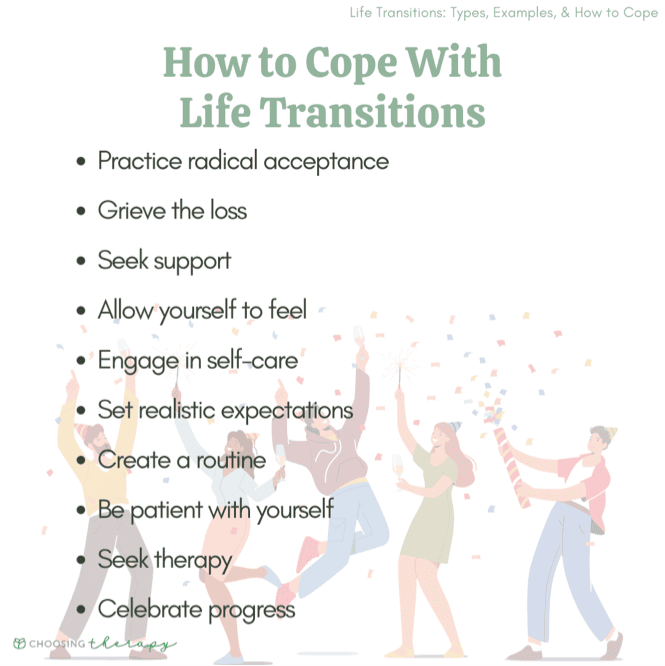
If you are finding yourself in that place, I want you to reflect on what you are leaving behind. Consider taking some time to journal about the parts of your old chapter you will miss, the routines, people, or roles you are grieving. Giving these thoughts some attention can help you honor your experience and make space for healthy processing.
Remember, acknowledging loss is an important step in moving forward.
Identity Shifts Are Hard Work
Most transitions aren’t just external changes. They’re internal reorganizations. They ask us, sometimes quietly, “Who am I now?”
Identity is built through repetition and familiarity. We’ve built confidence there, and we understand the expectations. We’ve learned how to move through those spaces without thinking too hard about it. But when those roles change? We don’t immediately feel steady in the new version of ourselves.
The experienced employee becomes the newbie.
The confident senior becomes the freshman.
The independent person becomes someone’s spouse or parent.
That shift can feel destabilizing, even when we wanted it. It’s a little like when you finally reorganize your kitchen during spring cleaning. You clean everything out, rearrange the things in the cabinets, and find a layout that makes more sense. It looks great. It functions better. You love it!
But for the first few days, you still automatically reach for the spoon in the old drawer next to the sink, except it’s not there anymore. You have to pause, try not to cut your finger on the knife you accidentally reached for, and remind yourself where things are now.
Nothing is wrong with the kitchen. It’s just reorganized, right? Well, identity works the same way. When we step into a new season, we internally reorganize. Our habits, expectations, and sense of competence all shift. For a while, we may feel like we’re reaching for a version of ourselves that doesn’t quite fit anymore. That doesn’t mean we’re regressing. It just means we’re rebuilding, and that rarely feels natural at first. It takes repetition before the new layout feels automatic again. Just like it takes time to reach for the spoon in its new spot, it takes time before the new role feels integrated. Internal reorganization is deep work, and it’s okay if it feels unfamiliar for a while.
We Rarely Allow Integration
Culturally, we celebrate milestones and skip over the integration part.
We announced the engagement, but we don’t talk about vulnerability.
We celebrate the promotion or new job, but we don’t talk about the imposter syndrome.
We throw the graduation party, but we don’t talk about the silent fear, wondering what’s next.
There’s very little permission to say, “This is good…and it’s stretching me.”
So we silence ourselves. We tell ourselves to be grateful. To toughen up. To stop overthinking. But minimizing doesn’t speed up integration; it just adds shame on top of adjustment. What would happen if we allowed ourselves to say, “This makes sense. This is a lot?”
Holding Joy and Grief Together
One of the healthiest emotional skills we can develop is the ability to hold and balance multiple feelings at once.
We can be proud and tired.
We can be grateful and grieving.
We can be excited and anxious.
Emotional maturity isn’t about eliminating complexity, but tolerating it. We want to tuck those feelings into a little box and slap a label on it with our mental label maker: happy, sad, excited, anxious. We want to keep it organized, contained, and easy to explain. Unfortunately for us, actual emotional experiences rarely cooperate like that. Transitions don’t either.
Transitions don’t usually fit into one category. They blur lines and move across multiple emotional spaces at once. When we try to force them into one neat little label, we end up invalidating part of what we’re actually feeling. When we stop trying to force ourselves into one emotional lane, we reduce our internal conflict. We give ourselves room to process honestly, which leads to steadier integration.

So, If You’re in a Season of Change
If you are proud of yourself, but also exhausted…
If you are grateful but quietly grieving…
If you are excited about what’s ahead but your body feels unsettled…
You are not failing. You are adjusting and carrying more than you were before, even if what you’re carrying is something beautiful. Transitions stretch and reorganize us. They ask us to loosen our grip on what was familiar and trust something we haven’t fully grown into yet. That takes energy, emotional flexibility, and it takes time.
So, if this season feels heavier than you expected, maybe nothing is wrong. Maybe your system is simply recalibrating to a bigger life. Maybe you are grieving and growing at the same time. Maybe the unsettled feeling isn’t a giant red flag, but a sign that something meaningful is unfolding.
The thing about growth? It rarely feels neat and comfortable while it’s happening, but uncertain and fragile. A seemingly endless in-between. That doesn’t mean you chose wrong. It means you are becoming.


Sorry, the comment form is closed at this time.