


11 Mar Internal Family Systems (IFS) for Kids:

Internal Family Systems (IFS) for Kids:
A Parent’s Guide to Understanding and Supporting Your Child’s Inner World
by
Joel Getter, LPC-S
Parenting can often feel like trying to understand Dr. Jekyll and Mr. Hyde. One moment your child is affectionate and cooperative, the next they are overwhelmed, angry, or withdrawn. Parents frequently ask: Why does my child act so differently depending on the situation?
Internal Family Systems (IFS) offers a helpful and compassionate way to answer that question. Instead of viewing behavior as “good” or “bad,” IFS invites us to see children as having many different inner “parts,” each trying to help in its own way. This framework can help parents respond with more empathy, reduce power struggles, and support emotional growth.
Here is some helpful information that will: 1) Give you a better understanding of IFS, 2) Apply it to your child’s rapidly changing behaviors, and 3) Provide some tools to help in de-escalating those frustrating situations.
What Is Internal Family Systems (IFS)?

Internal Family Systems is a therapeutic model developed by psychologist Dr. Richard Schwartz. Basically, every person has an internal system made up of different “Parts,” much like a family. These parts have their own feelings, beliefs, and roles. Surely, you’ve seen both Inside Out movies (No judgments if you haven’t, but I highly encourage it).
IFS also proposes that beneath all these parts is a person’s Self—the calm, curious, compassionate core of who we are. The Self is not a part; it is our natural capacity for calm, connection, and leadership, bringing everything into a harmonious balance.
Rather than trying to eliminate difficult behaviors or emotions, IFS focuses on:
- Understanding why a part exists
- Appreciating its protective intentions
- Helping the Self lead the system more effectively
- For children, this approach can be especially powerful because it normalizes emotional complexity and removes shame. As Dr. Schwartz says, “There are no bad parts.”
The Three Main Types of Parts
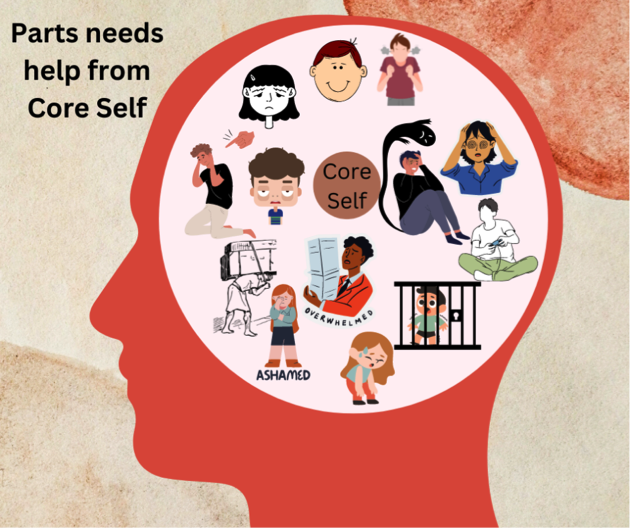
IFS organizes parts into three broad categories. While these labels come from adult therapy, the same patterns appear in children.
1. Exiles
Exiles are parts that hold painful emotions such as fear, sadness, shame, or loneliness. These parts often carry memories of moments when the child felt hurt, rejected, or overwhelmed.
Here are a few examples:
- A part that feels scared after being bullied
- A part that feels unlovable after repeated criticism
- A part that feels abandoned after a separation or loss
- Exiles are often pushed out of awareness because their feelings are too big or uncomfortable.
2. Protectors
Protectors exist to prevent the child from feeling the pain held by exiles. They usually fall into two subtypes:
Managers – try to control situations to avoid distress
Examples:
- Perfectionist behavior
- Excessive people-pleasing
- Emotional shutdown
Firefighters – react when emotional pain breaks through
3. The Self
The Self is the child’s natural state of well-being. In IFS, these are called the “8 Cs” of Self:
- Calm
- Curiosity
- Clarity
- Compassion
- Confidence
- Courage
- Creativity
- Connection
In a safe and supportive environment, children can have an abundance of self-energy (just like us grown-ups).
Why IFS Works Well for Kids

Children already think in imaginative, symbolic ways. Talking about “parts” feels intuitive to many of them. I remember when I was a kid (long ago in a time with dinosaurs as far as the eye can see). I would have so many different feelings regarding going to school:
- “A part of me wants to go to school.”
- “Another part of me is scared.”
- “There’s a part of me that gets really mad.”
IFS gives structure and language to something kids already experience.
Benefits for children include:
- Reduced shame around emotions
- Increased emotional literacy
- Better self-regulation
- Stronger sense of inner safety
- Improved communication with caregivers
- Instead of seeing themselves as “bad,” children learn: Something inside me is struggling—and it makes sense.
How This Looks In Everyday Parenting

The language of IFS helps create a shift from “What’s wrong?” to “What’s happening inside?”
Traditional discipline often asks “Why are you behaving like this?”
IFS asks:
- “Which part of my child is activated?”
- “What is that part trying to protect?”
Here’s an example. A child refuses to go to school and becomes aggressive.
Instead of labeling them as defiant, IFS invites curiosity:
- Is there a scared part that feels unsafe at school?
- Is an angry part protecting a hurt part from feeling rejected?
- This shift moves parents from control to understanding.
Speaking the Language of Parts at Home:

| ||
Helping Children Access Their Self
Modeling is everything:

Maybe not that kind of modeling, although he is really, really good-looking. But modeling being in Self energy helps children learn. Responding with calm rather than reactivity, and curiosity instead of judgment goes a long way.
The goal of IFS is not to eliminate parts, but to help the Self lead. Parents can support this by modeling Self energy themselves.
Simple practices that support Self:
- Naming emotions
- Deep breathing together
- Offering choices
- Slowing down during conflict
- Validating feelings before problem-solving
Here’s an example:
“I see how angry that part of you is. Let’s take a breath and listen to what it needs.”
Using IFS During Big Emotions:

When a child becomes dysregulated, we often try logic to resolve it. But those Protectors have the floor, so we have to try a different approach.
IFS suggests three steps:
1. Connect with the part
- Acknowledge what is happening:
- “It looks like a really overwhelmed part is here.”
2. Get curious
- Ask gentle questions:
- “What might happen that worries this part?” “What does it need right now?”
3. Offer safety
- Reassure:
- “I’m here.” “You don’t have to handle this alone.”
- This process teaches children that emotions are survivable and understandable.
Trauma and the IFS Lens

IFS is especially helpful for children who have experienced trauma, loss, or chronic stress.
Trauma often creates:
- Highly activated protectors
- Exiles carrying fear and shame
- Reduced access to Self
From an IFS perspective, many trauma-related behaviors (aggression, withdrawal, anxiety) are protective strategies—not character flaws. For example, a child who cries frequently may have a protector trying to avoid punishment. A child who dissociates may have a protector shielding them from emotional pain. This lens encourages compassion instead of blame.
What IFS Is Not
Now that you know what IFS is, I think it’s important to clarify what IFS does not mean.
IFS does not:
- Let children avoid responsibility
- Remove boundaries
- Excuse harmful behavior
- Replace consequences with permissiveness
IFS does mean:
- Understanding behavior before correcting it
- Separating emotions from actions
- Maintaining limits while staying emotionally attuned
Here’s an example: “I understand the angry part of you wanted to hit. It makes sense. And hitting is not okay. Let’s find another way to help that part.”
Practical Activities for Parents
- A worried monster
- A brave superhero
- A sleepy cat
- This externalizes emotions and reduces overwhelm.
When to Seek Professional Support
Why This Approach Is So Different from Traditional Models
While parents can use IFS principles at home, some situations benefit from professional help:
- Ongoing anxiety or depression
- Trauma or attachment issues
- Extreme behavioral challenges
- Self-harm or aggression
- IFS-trained child therapists can help children safely explore deeper emotional layers.
Many parenting strategies focus on controlling behavior from the outside. IFS focuses on understanding behavior from the inside.
- Traditional view: “My child is difficult.”
- IFS view: “My child has parts that learned extreme ways to cope.”
This shift:
- Reduces parental burnout
- Increases empathy
- Strengthens attachment
- Builds lifelong emotional intelligence
- Children raised with this mindset grow up believing: “All parts of me are welcome, even the hard ones.”
The Long-Term Impact of IFS-Informed Parenting
Children who learn to relate to their inner world with curiosity and compassion often develop:
- Stronger emotional resilience
- Better conflict resolution skills
- Greater self-trust
- Lower internalized shame
- Healthier relationships
- They learn that emotions are messages, not threats.
- Instead of suppressing feelings, they become capable of listening to them.
Final Thoughts: Seeing Your Child as a System, Not a Problem
IFS invites parents to see their child not as a collection of behaviors to manage, but as a complex inner ecosystem trying to survive, adapt, and grow. When a child screams, shuts down, or resists, something inside them is asking for understanding—not control. By learning to speak the language of parts, parents gain a powerful new question: “What is this part of my child trying to protect?” That single question can transform discipline into connection, conflict into curiosity, and parenting into a deeply relational experience.
Parenting can certainly be a roller coaster that often feels as if it’s out of control. I hope this information on incorporating IFS is helpful. And never forget the most important lesson of all to both you and your child:
Nothing inside you is broken. Every part has a reason for being here.


Sorry, the comment form is closed at this time.