


12 Feb Cultivating Connection in Your Marriage, Part 2

Cultivating Connection in Your Marriage, Part 2
Using Your Conflicts to Grow Closer
by
Kelly Kennedy, LPC Candidate
In our July 2025 blog post, I wrote Part 1 in this series on Cultivating Connection in Your Marriage (or any relationship).
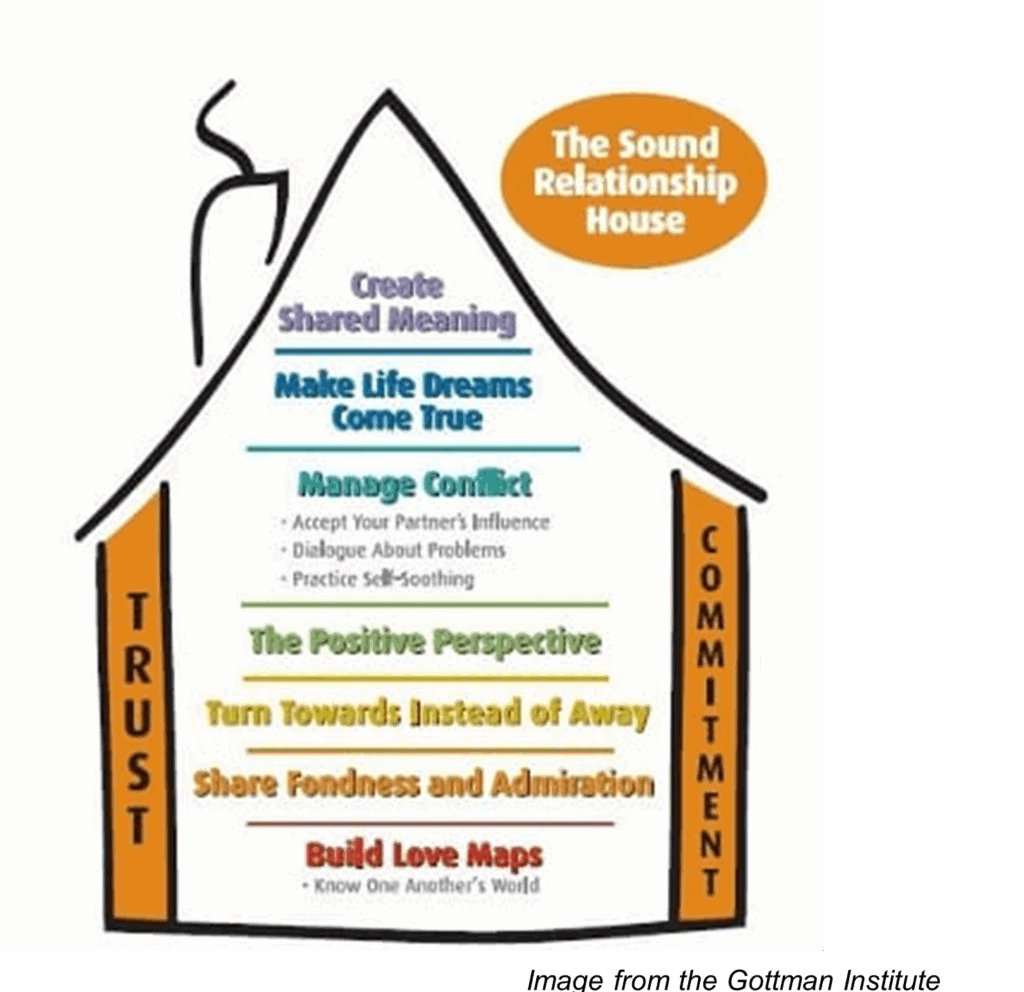
That post focused on the first three levels of Drs. John and Julie Gottman’s Sound Relationship House: Build Love Maps, Share Fondness and Admiration, and Turn Towards Instead of Away. In that post, I explain what each level is and give practical tips to cultivate it in your relationship. If you haven’t read it, I encourage you to read that post before this one. Each of these concepts build upon one another!
THE POSITIVE PERSPECTIVE
When a couple’s friendship and intimacy are strong (what those first three levels work to build), the couple enters into what the Gottmans call “The Positive Perspective.” When the couple has more positive interactions than negative ones built up in their “emotional bank account” (a ratio of 5:1, to be exact), a remarkable thing happens: The couple begins to see their whole relationship – past, present, and future – in a more positive light. Your partner’s faults, blaring before, now seem more like quirks that are a part of the whole package. That horrible fight from a few years ago? It hurt, but it was a stepping stone to the richer, deeper place you are now. Being intentional and consistent in your marriage can literally rewrite history.
MANAGE CONFLICT
There’s a reason the first three levels of the house build friendship and intimacy before the seemingly behemoth task of managing conflict. Having that positive perspective makes managing conflict not only feel easier, but it also reveals an opportunity for humility and growth. Healthy couples experience conflict and have learned to fight well, allowing the stress of being both imperfect and different from one another to transform rather than crush them. Managing conflict well involves:
Accepting Influence: This is statistically more challenging for men than women, but it has a paradoxical effect; when a partner is willing to accept influence from the other, they end up having more influence in the relationship. This involves setting aside your own perspective and agenda to understand and validate your partner’s subjective experience, allowing it to permeate your own. As a personal example, my husband uses his phone for many parts of his job. When he’s home and “off,” I get angry when I see him scrolling. I start to feel as though our family is less important than what’s going on in the virtual world. I feel protective of our time together. To be honest, I’m the kind of person who quietly stews over that before bringing it up in an explosive manner weeks later. However, by the actual grace of God, there are moments when I can bring this up in a more helpful way. One day, I told him about all the thoughts and feelings that go rushing through my mind when I see him scrolling. He listened without a trace of defensiveness and really took my perspective to heart. It’s not perfect, but I can tell a difference in how he uses his phone and how he interacts with us at home. When he is on his phone, I’m able to bring it up again in a playful manner; it doesn’t feel like a direct attack on me anymore. He had accepted my influence, and I felt our trust and intimacy grow a few feet deeper.

Dialogue About Problems: Usually when a partner brings up an issue, they do so in a critical way, “You never pick up your shoes!” or “You are always late for dinner!” At other times, this critical approach can emerge more subtly – A cold shoulder, rolling of the eyes, or a snide, sarcastic comment. Generally, this provokes defensiveness in the person receiving the critique. Many of the couples I’ve worked with over the years are stuck in a pattern of criticism and defensiveness. This makes it incredibly hard to have a productive dialogue about problems. The first step I use for these couples is to practice the Gottmans’ “Gentle Start-Up” when bringing up an issue:
I feel when . I need .
For example: “I feel disappointed and angry when you don’t come home when you originally said you would. I need you to text me when you’re running behind”.
You’re speaking from your own experience when a specific thing happens, and you’re stating a positive need that shows your partner how they can shine for you. In turn, your partner can more easily hear you and accept ownership for their part in this.

Practice Self-Soothing: You may have felt it before– you’re so angry that you can feel your heart thumping against your chest. Your ears feel hot. You’re starting to repeat yourself and you almost can’t see straight. Part of you just wants to bolt or shut down, if not for the part of you that so desperately wants to prove a point. You, my friend, are what the Gottmans call “flooded.” The best way to know if you experience this during your conflicts is to check your heart rate. If it’s over 100 bpm (or over 80 if you’re an athlete), you are likely flooded. This means that your brain is in fight-or-flight mode, giving you limited access to the parts of your brain that can control your impulses, regulate emotions, reflect, and make deliberate decisions. The Gottmans emphasize that every couple needs to have a “take a break” plan for these moments. When you notice yourself becoming flooded, let your partner know that you need a break. Then do something relaxing and unrelated to the conversation, alone, for at least 20 minutes (read a book, take a walk, or do some breathing exercises), and reassure one another that you will come back to the conversation within 24 hours.

Managing conflict is a vast topic in Gottman’s research, and one that I will return to in future posts. However, I hope this overview encourages you to start small with building your friendship and intimacy. Consistency and intentionality are crucial for building that positive perspective that functions like oil in your car engine. I hope it also reminds you that conflict is good and normal; if you can fight well, conflict doesn’t have to crush you. It can be the key to a richer, more fulfilling marriage.
As always, reach out to us at Empowered Life if your relationship could benefit from our individualized support!

Sorry, the comment form is closed at this time.