


22 Dec The 3 Relationship Buckets

The 3 Relationship Buckets
by Jeremy “Ferg” Ferguson, LMFT-S

I want a peaceful holiday. Wouldn’t that be nice? It felt like the holiday season was so much more peaceful when I was a little kid. All I had to worry about was which Christmas movie I was going to get to see that week. I was always upset if I missed the Grinch airing on TV. Thank God for VCRs and scheduled recordings! Then I could watch it as many times as I wanted! What a wonderful thing. *sigh*

Those were simpler times…most likely because my parents were taking care of all the holiday planning. I just got to enjoy! As adults, we don’t get the privilege of being shielded from the stress of the Christmas season. Nah, we get to add a heaping pile of stress and expectations. And then there are the relationships we “get to” deal with. All that stress is conveniently amplified when you add your relatives to the mixture. Demands, unspoken expectations, to-do lists, family meet-ups, and exchanges…not to mention when you have people pressuring you to celebrate the way they want to celebrate…It starts looking like you are setting up to have a pretty bad batch of cookies, Santa.

There is no season like the Christmas season for family drama. Man, I hear about some of the Toxic behavior of some of your family members out there…You can’t make some of this stuff up! If it were on a CW teen drama, I would not believe you! You poor people. Ha ha.
So what is a healthy way to approach your family relationships during the holidays?
Boundaries, I say to you!
Now, I am not going to tell you about all the boundaries to place; that depends on your specific situation. I can, however, help you look at the types of relationships you do have and categorize them to help give you a general sense of what boundaries you can/should set with those relationships. I put relationships into 3 relationship buckets (categories). Just think about your relationships and ask yourself, “What bucket does this person belong in?” Then you can set boundaries accordingly.
“The saying is trustworthy, and I want you to insist on these things, so that those who have believed in God may be careful to devote themselves to good works. These things are excellent and profitable for people. But avoid foolish controversies, genealogies, dissensions, and quarrels about the law, for they are unprofitable and worthless. As for a person who stirs up division, after warning him once and then twice, have nothing more to do with him, knowing that such a person is warped and sinful; he is self-condemned.”
Titus 3:8-11

Bucket #1: The Healthy Bucket
The healthy bucket is the place to be during the holidays. These are the people who are not high drama folk. They respect your limits and understand the idea that you are a human being with a life and responsibilities. They allow you and even INVITE you to tell them a good, honest “no.” They listen to your “no” and take it seriously without taking it personally. When you say, “I am not going to be able to make it on that day,” they respond with something like a “Bummer. You will be missed,” or “Gotcha, let’s see if we can pivot the date to a time everyone can make it.” This is so much better than one of those nasty guilt trips. People in the healthy bucket also take responsibility for their mistakes and how they impact you. “I’m so sorry, dear. I never want to make you feel this way. I should have communicated better.” These are people who are life-giving and are a joy to be around more often than not. They hold up to their end of the relational bargain and don’t just bring a bag of ice to the party…they actually contribute when they can. They are predictable people who put little pressure on family members or friends. Peace seems to be where they are. Peace is the emotional experience that you feel when you spend time with people in this bucket.

Bucket #2: The Foolish Bucket
This bucket is an interesting one. It’s the bucket with relationships that are often extremely fun and entertaining. Think of the stereotypical college buddy. When you were in college, you may have gone out to “live it up” a bit on a weeknight. Hey, you were young and had no real consistent schedule. You could bounce back the next day just fine. But then you jump into the workforce or a consistent parenting schedule with your kids going to school, and if you make choices like that, and it would absolutely wreck the next day. But then you have that friend or family member who invites and pulls at you to do the “hang out” thing again…But you know what that means. It’s another late night on a weekday, and being hungover the next day when you have responsibilities is dreadful! People in the foolish bucket are a lot of fun, but do not always make the best choices. They typically mean well, but their desire for “a good time” or to recapture the nostalgia of simpler, less responsible times clouds their ability to make healthy choices…or they just don’t care enough to make those good choices. “To heck with it! I am going to have fun, and you should too!” Regret is the emotional feeling that comes with this bucket. You end up asking yourself, “Why did I do that? That was silly.” Oftentimes, we get pressured into doing stuff we know is not a good idea out of a misunderstood concept of fun or self-care. Or even worse, we feel a sense of guilt or obligation to make sure that OTHERS have fun at our expense. Like, somehow, you not being there or participating in the poor decision-making will ruin the “good time” for them. This is simply not the case.

Bucket #3: The Toxic Bucket
Toxic is a word that is thrown around kind of willy-nilly lately. I have been hearing people referred to as toxic just because they disagree with someone’s opinion or life choices. This is not the case. We can respectfully and lovingly disagree or have boundaries with one another. Just because someone holds firm boundaries or a strong opinion DOES NOT MAKE THEM A TOXIC PERSON. They may hold hurtful opinions, but it is not HARMFUL. Going to the dentist is hurtful, but good for you. Getting curb stomped is harmful. See the difference? One is doing something that is good for you, but causes discomfort and pain, while the other is intentionally trying to cause damage to you.
Toxic = consistent patterns of behavior that are harmful to your emotional, spiritual, or relational well-being.
This rules out the occasional mistake…this has to be consistent, harmful patterns of behavior. The main feeling that comes with these relationships is grief. This leads me to the three traits of toxic people that author Gary Thomas speaks about in his book When to Walk Away.
1: Control Monger: Toxic people are controlling and manipulative. They do not have respect for your boundaries and will actively clash against them when you try to hold them up. They will try to gaslight you, pressure you, and guilt you into doing what they want you to do. They want to dictate your time, your relationships, and your priorities. You see this often during the holidays, especially if you are trying to figure out the scheduling of when you are going to celebrate with certain members of your family. “We always go to my parents’ house cause my mom will have a conniption fit and there will be hell to pay.” I know people who have tried telling their parents that they were going to the in-laws on Christmas day, and the responses are pressure-ridden and controlling. “We have always celebrated Christmas together on Christmas Day. Why don’t you love me anymore!?!? I raised you. The least you can do is come to my house on Christmas Day. They will understand. “ Sometimes they will then turn to threatening to destroy your reputation…which leads to our next trait.
2: Murderous Spirit/Attitude: Toxic people will attempt to bring intentional harm to you. This is not always physical. In fact, it’s often intentionally trying to destroy your peace of mind, joy, or purpose. Often, this is aimed at crushing your reputation with others. They may try to intentionally humiliate you. They want to bring destruction to you in some way. Murderous is a great word to capture the heart that they have. They want to take you out, to emotionally (or in some cases spiritually) sabotage you. Maybe it’s constant criticism or belittling. Maybe it’s spreading rumors about you. Maybe it’s trying to accuse you of things that you have not done to get you to second-guess your choices and to wreck your confidence. Murderous people are masters of reputation destruction…even if it’s in your own head. They enjoy it. They also enjoy drama, which brings us to this last trait.
3: Lovers of Hate: They feed off conflict, drama, and hostility. Loving hate means that these people look for ways to spread ill will towards others. I like to think of this as dragging Hell up into your everyday life. This is a very bitter lifestyle that enjoys spreading that bitterness around. They stir up trouble, division, arguments, and show no interest in reconciliation, repentance, or growth. They want more negativity, chaos, and strife. If you know someone who says things about other people to create tension and then celebrates when people squirm…THIS IS THEM. This would be like when that toxic family member tells you something personal about another member of the family and then tells that family member that you are judgmental…Or when two members of the family are arguing, and this toxic person jumps in to one of the sides when it’s none of their business. It’s just gross…TOXIC.

Peace, regret, or Grief. There is only one of those emotional experiences I want to set myself up to experience…especially during the holidays.
Ok. You have stuck with me this long. Great! Now what do we do with these buckets? Well, one thing is to recognize your relationships and how they impact you. This will help inform you of what boundaries to set in place in those relationships.
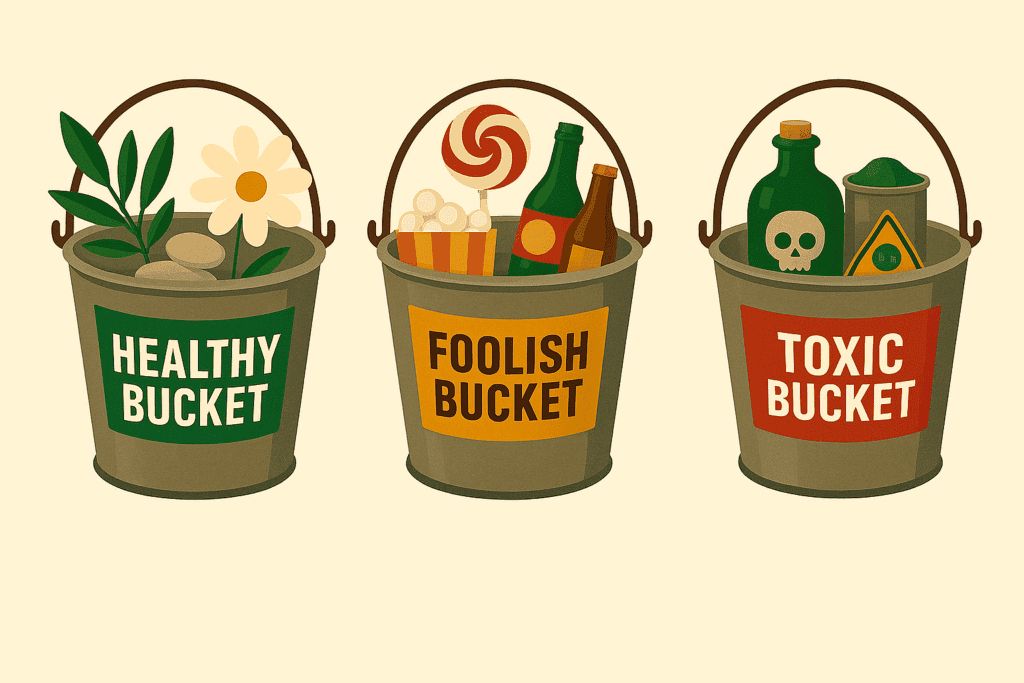
Healthy Bucket: Does not need a lot of boundaries, as they listen to your needs. These are safe and secure people that you can be vulnerable with. These are very personal/intimate boundaries. You can always assess these boundaries with healthy bucket people and can easily pivot as needed, as they will respect any limits you set.
Foolish Bucket: These will need a little firmer boundaries. These are not unsafe people, but they can cause pain if you are not careful. So think of this as friendly/responsible boundaries. As a person in the foolish bucket wises up, you can adjust your boundaries accordingly. They just have to earn some more trust, especially as you continue to live your wisdom-seeking life. The other thing to be aware of with foolish bucket people is that they are constantly moving towards the healthy bucket or the toxic bucket. Either their own foolishness will cause enough pain to where they learn from their mistakes and wise up, or they will become bitter from their own pain and will start to develop toxic traits. So these relationships have to EARN TRUST so we don’t set ourselves up for pain as well.
The Toxic Bucket: You have to have professional boundaries with individuals in this bucket. Usually, this means just not having a relationship with them or severely limiting your interactions with this relationship. You have to be VERY FIRM and STRICT with your boundaries with toxic bucket people. This is to help you guard your peace and not be robbed of fun Christmas memories. This means that you will most likely have to deal with a little bit of anger…bitterness…and most likely a lashing out at you if you tell them you now have boundaries. If this seems intimidating to you…you ARE NOT ALONE!!! Wonderful books like When to Walk Away by Gary Thomas, Boundaries by Dr. Henry Cloud and John Townsend, and Set Boundaries Find Peace by Nedra Glover Tawwab will be very helpful.

Guard your peace this holiday season, ya’ll. You can have one of the best Christmas breaks you have had in a long time if your boundaries and relationships are aligned correctly. My challenge to you is to re-examine who you spend the holiday season with and ask yourself, “What bucket is this relationship?” Then re-examine whether or not your boundaries are set according to their proper bucket.
Foster holiday peace. It’s worth it. YOU are worth it.
Get to it!
– Ferg

Jeremy “Ferg” Ferguson, LMFT-S
Jeremy, also known as “Ferg,” is a Licensed Marriage and Family Therapist with a master’s degree in Christian Counseling – Marriage and Family Therapy from Oral Roberts University. His skills as a family therapist are versatile and allow him to work with all ages of the family including children, adolescents, and their parents. Ferg works with his clients individually, as a family, or with couples.
Ferg is passionate about helping his clients grow and experience emotional healing and freedom through his relational personality and style of therapy. The safe environment he creates allows his clients to practice giving their feelings and needs a voice while they are simultaneously challenged with loving “pushback” to develop a deeper connection and create a more desired life experience.
Ferg is trained in Eye Movement Desensitization and Reprocessing (EMDR) and has seen how helpful this model can be to clients who have been impacted by past traumatic events that adversely affect their present lives. He is also a skilled couples’ therapist and is trained in Emotionally Focused Therapy (EFT) which helps him lead couples through healing
attachment injuries and develop secure bonds. With his cheerful energy and
compassionate spirit, Ferg sojourns alongside his clients as they venture forth
in their quest to slay the dragons of their life.
Sorry, the comment form is closed at this time.